Northern Cardinal
Cardinalis cardinalis
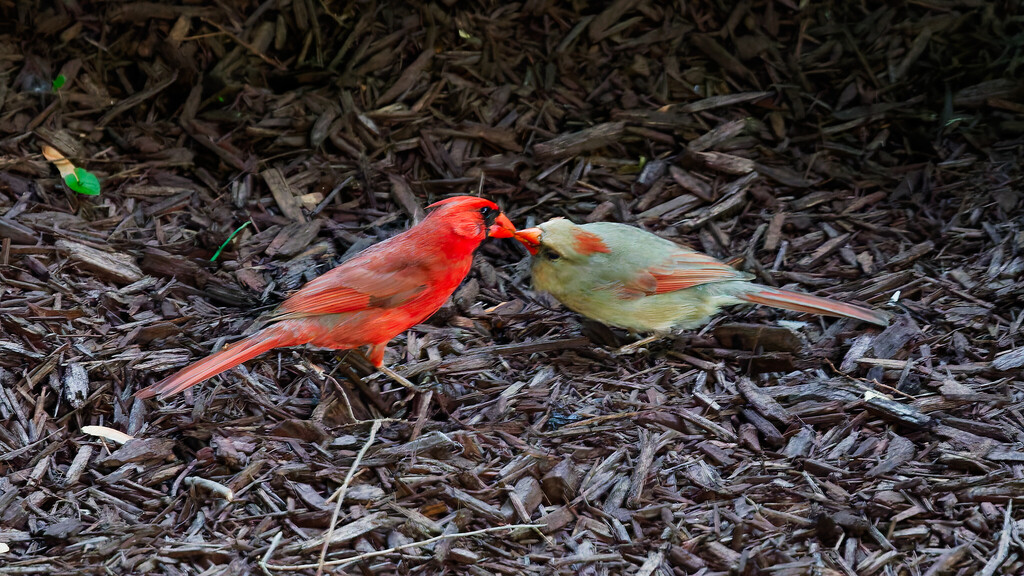
Males are brilliant red with a black face mask and crest; females are warm buff with red wings, crest and tail.
- Family
- Cardinalidae
- Order
- Passeriformes
- Size
- 21–23.5 cm long · 33–65 g
- Status
- Native in United States
- Records
- 329,220
- Peak
- May · Apr · Mar
How to recognise
What you are looking at
Males are brilliant red with a black face mask and crest; females are warm buff with red wings, crest and tail.
Typical size: 21–23.5 cm long · 33–65 g
Habitat & behaviour
Where it lives
Woodland edges, thickets, gardens and park undergrowth.
How it behaves
Secretive but vocal; holds territory year-round and visits feeders early and late.
Diet & timing
What it eats
Seeds, berries, insects and fruit.
When to look
Early morning and just before dusk, year-round.
Field tip
A sharp metallic chip usually gives away a bird hidden in dense shrubs.
Seasonality
When it shows up
November: possible
Where to look
Places with recent records
Woodland, meadows, lakes
Central Park
The most famous urban park in the world is also a serious migration trap: the Ramble and the Pond concentrate warblers every spring.
Woodland, lake, meadow
Prospect Park
Brooklyn’s 526-acre answer to Central Park, with a wilder woodland edge and a lake that pulls in herons, grebes and waterfowl.
Salt marsh, mudflat, open water
Jamaica Bay Wildlife Refuge
A 9,000-acre estuary within the city limits — the best shorebird and waterbird habitat in New York, and a stopover for migrating horseshoe crabs.
Old-growth forest, caves, shoreline
Inwood Hill Park
Manhattan’s last remnant of old-growth forest, perched on schist above the Hudson and the Harlem River ship canal.
Forest, salt marsh, beach
Pelham Bay Park
The largest park in the city: oak forest, Orchard Beach, and a lagoon system that fills with wading birds in summer.
Waterfront, piers, planted gardens
Brooklyn Bridge Park
A reclaimed industrial waterfront where cormorants, terns and peregrines hunt between the bridge towers.
Easy to confuse with
Similar species in New York City
Questions
Northern Cardinal in New York City
- Where can I see Northern Cardinal in New York City?
- Northern Cardinal has recent records at Central Park, Prospect Park, Jamaica Bay Wildlife Refuge. Check each park page for habitat notes and access.
- When is the best time to see Northern Cardinal in New York City?
- Records peak in May, April, March. In November, activity is rated “possible”.
Sources
Occurrence counts and seasonality are derived from GBIF records (2018–2026). Description adapted from Wikipedia via iNaturalist, licensed CC BY-SA. Photo credits appear under each image. Native or introduced status comes from iNaturalist regional checklists. Species pages are for observation only — never disturb wildlife.